Sweden
Out Stealing HorsesSweden is not a distant setting in the novel but the country folded into the valley’s daily geography: the river crosses the border, timber is sent downstream to Swedish buyers, and a wartime escape and a later ride with Trond Sander’s father lead east across the same frontier. Its meaning shifts with each crossing, from practical destination to guarded passage and finally to a place the narrator recognizes through the river itself.
Border Geography
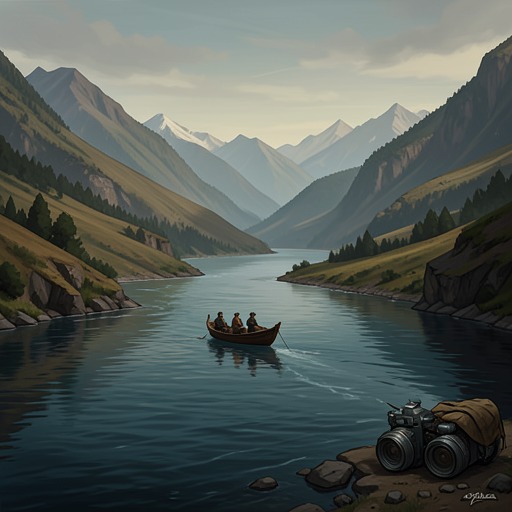
The village lies only a few kilometres from the Swedish border. The river runs in a broad curve from Sweden through the village and then back into Sweden farther south, making the political boundary both unmistakable and strangely permeable. As a boy, Trond wonders whether water that has crossed into Norway might somehow still taste or feel Swedish, though he recognizes the thought as a fancy. The river’s course gives that childhood speculation a physical basis: the same water belongs to both sides of the border.
The boundary is experienced through ordinary routes as well as maps. Trond and Jon walk between Barkald’s fields, the road, the shop, and Jon’s home; the larger landscape is one of small farms, forest, and river, with Sweden close enough to shape local work and travel. The border does not divide two wholly separate worlds. From the ridge above the valley, Trond sees the river winding through meadows, then turns east toward a country he has never visited and assumes, without being told, is where he and his father are going.
Timber, River, and Trade
Sweden is a commercial destination for the timber Trond’s father decides to fell. The plan is to haul the trunks to the river and float them downstream to a sawmill in Sweden. Barkald has a farm saw about a kilometre away, but it may not be large enough for the quantity being cut. The Swedish buyers will not pay for timber where it is felled; they will pay only for what reaches the timber yard, and they refuse to take responsibility for rafting it in July. The arrangement makes the river’s flow part of the economic bargain: the work and its risks remain with the men sending the logs away.
The timing adds danger. Franz warns that timber cut at midsummer is heavy with sap, roughly twice the weight it would have at another time of year, and the horses cannot haul as much. The water is also low and falling, raising the possibility that the logs will sink. Later, Trond and his father ride south into Sweden and find that some of their timber has become stranded: one log is jammed among rushes, more are caught on a shoal, and a larger pile is wedged between rocks in shallow water. Trond’s father cuts poles from two small pines, and they wade out in their shoes to push logs back into the current. The Swedish stretch of river is therefore not a safe endpoint but another working part of the route, where the river’s condition can undo the labor expended upstream.
War and Passage
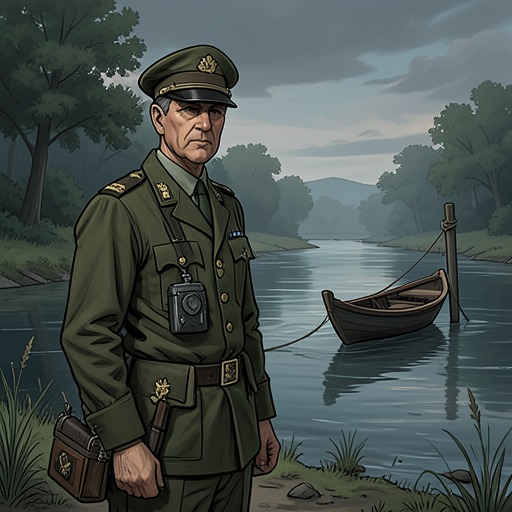
During the German occupation of Norway, the border region is also a space of surveillance and escape. A German patrol is stationed on a farm near the church and shop, and a guard is often posted at the gravel approach to the bridge. The bridge is a watched threshold: Trond’s father crosses it while making conversation with the guards in German, learning details about their backgrounds and preferences rather than treating them as interchangeable figures. The river, bridge, and roads together form a passage whose use depends on both local knowledge and the occupiers’ attention.
When Franz sees a motorcycle approaching, he retrieves the hidden detonator from beneath four floorboards and destroys the wooden bridge. The explosion breaks the route the guard and rider have been using; the guard survives but is deafened, and the two soldiers turn away. At the riverbank, Jon’s mother and a suited stranger are pursued by the soldiers. Trond’s father shouts for them to run and heads through the trees toward the river as shots strike the trunks and hit the stranger. These scenes establish the border landscape as more than a line separating states: in wartime, its crossings and approaches become part of a dangerous escape route. The river is simultaneously an obstacle, a possible way out, and a landmark around which resistance and pursuit unfold.
Crossing into Sweden
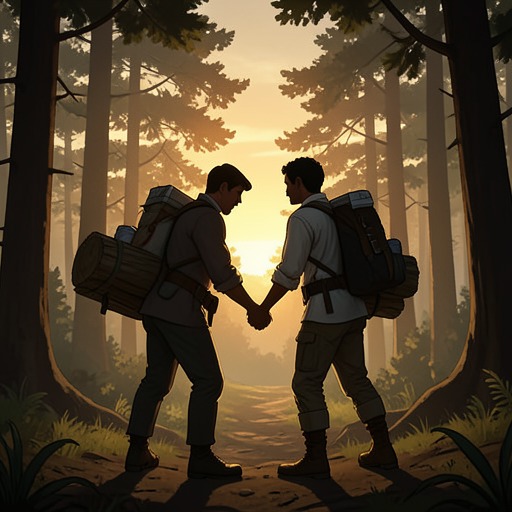
Years later, Trond and his father ride over Furufjellet and turn east. Trond is impatient to continue; the valley’s view from the ridge does not make him melancholy so much as irritated by the delay. He expects Sweden to look like the Norwegian side while feeling different because it is unfamiliar. The descent through a narrow, stony pass makes the crossing tangible, but the ride is no longer shadowed by the German patrols and border police Trond imagines as possible pursuers.
The river confirms that they have reached the other side. Trond hears it before seeing it, then recognizes it as their own river, now farther south and well inside Sweden. The recognition is intensely personal rather than cartographic: although water cannot literally be identified by its flow, he knows it. The border has been crossed, yet the river remains continuous. Sweden is thus both foreign ground and a continuation of the landscape Trond already knows, a distinction the novel makes through movement, labor, and memory rather than through a simple change of scenery.